The School and the Fire
Germany's Schools and Its Wars. A Lesson for AI?
For two centuries, defeated nations turned to their schools, and the same classrooms produced both renewal and revenge. From Fichte in occupied Berlin to the book burnings on the Opernplatz, a story about education as a catalyst, and a question about AI.
Steve Jobs famously called the computer “a bicycle for the mind,” a tool that propels thinking. Like a bicycle, the computer helps us go farther with the same effort. Our age has introduced another such tool: artificial intelligence. AI can catalyze the human mind, but what it produces depends on us. Education can shape a generation, but what it creates depends on what that generation is taught.
We think this is unprecedented, but it is not. For two centuries, defeated nations have turned to schools as a force for renewal. At times, wounded pride was planted in the classroom, and what grew was nationalism and the exclusion of those deemed outsiders.
Before we ask how AI might shape our future, it may be worth looking at what two centuries of education can teach us. This is a story about education’s promise—and the fires lit in its name. It is also a story about national wounds and the choices they shaped. If AI is our generation’s school, what are we teaching it, and what is it teaching us?
I. Berlin, December 1807
The drums of the French garrison could be heard on Unter den Linden that Sunday, as on every Sunday. Inside the round hall of the Academy of Sciences, a man of forty-five with a hard jaw and a voice trained in pulpits stood up to speak.
Johann Gottlieb Fichte had fled Berlin the year before, when Napoleon’s army came after Jena. He had gone to Königsberg, then to Copenhagen, and he had come back to a city that no longer belonged to its king. French officers sat in the cafés. French censors read the newspapers before the Berliners did. Everyone in the hall knew that a lecture of the wrong kind could end in arrest, and there were rumors that the censor had already marked him.
He spoke anyway, fourteen Sundays in a row, through the winter and into March. The Addresses to the German Nation began from a simple premise: the armies were gone, the state was broken, and there was nothing left to fight with. Nothing, he said, except the one thing a conqueror cannot occupy. A new education. Not the drilling of facts into children, but the forming of whole persons, who would act from their own inner freedom. A people formed that way could not be held down forever.
It was an argument for the school. It was also something else. In the same lectures Fichte told his listeners that the Germans were an original people, an Urvolk, whose language had never been broken by foreign conquest, and who therefore carried a deeper truth than the nations around them. The French had taken the land. The spirit, he promised, was still German, and superior.
Two seeds went into the ground that winter in the same furrow. Nobody in the round hall could have told them apart.
II. Rome and Berlin, 1809
Wilhelm von Humboldt did not want the job. He was in Rome as the Prussian envoy to the Holy See, living among ruins and books with his wife Caroline and their children, and he had built there the kind of life a scholar dreams of. When the summons came to return to Prussia and run the section for education, he hesitated for months. Caroline stayed behind in Rome.
He accepted in February 1809, and he worked as if he knew he would not have long. He had spent twenty years thinking about one question: how does a human being become fully human? His answer was Bildung, the formation of the self through freedom and through contact with the whole range of human knowledge. The state, he had written as a young man, should do as little as possible, and above all it should not tell minds where to go.
Now the state was asking him to build its future. He answered by building a place where the state would keep its hands off. A university where teaching and research were one, where professors followed their questions and students followed their professors, in solitude and freedom, Einsamkeit und Freiheit. Knowledge, he wrote, should be treated as something never fully found, and always to be searched for.
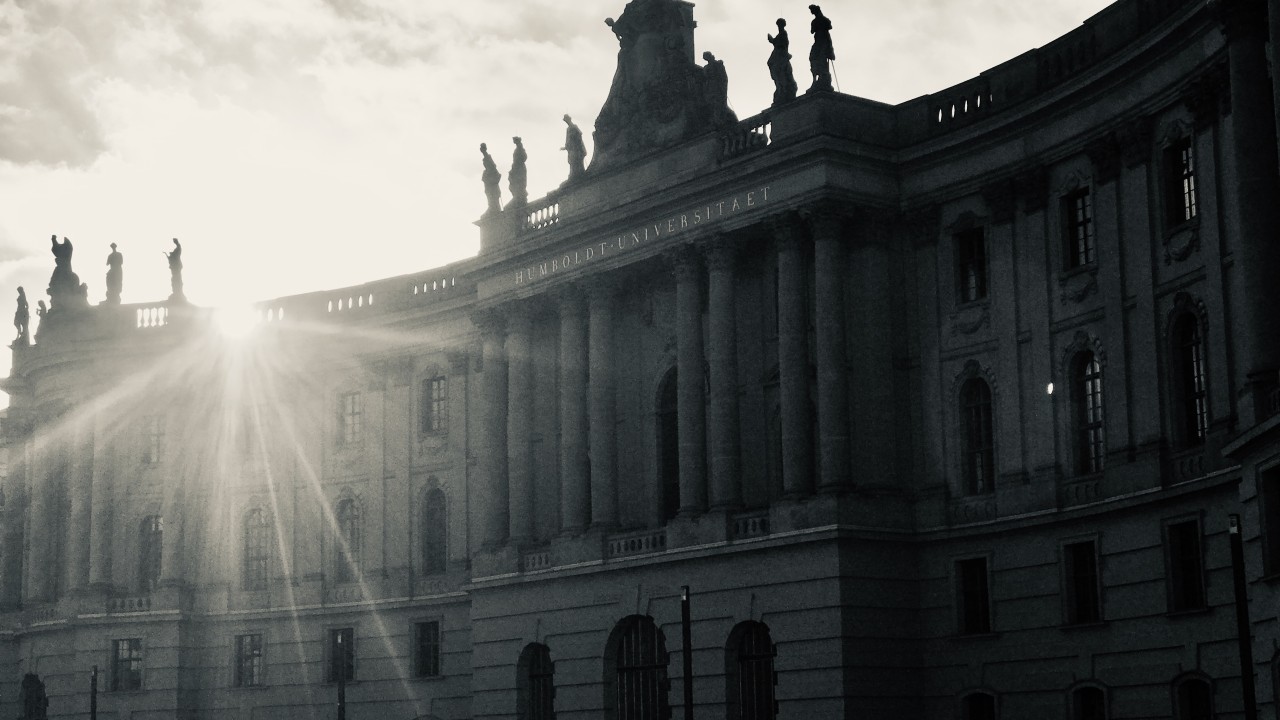
The king gave him a building: the palace of the late Prince Heinrich on Unter den Linden. Its front faced a wide square beside the opera house.
Humboldt resigned in June 1810, after sixteen months, frustrated by court politics. He was not there when the university opened that autumn. Among its first professors was Fichte. The next year the faculty elected Fichte rector.
In that office, in 1811 or 1812, a student named Friedrich Friesen brought him a document to review. It was a draft constitution for a new kind of student association, a Burschenschaft, drawn up in the circle of the gymnastics teacher Friedrich Ludwig Jahn. It imagined German students bound together by fatherland and honor. Fichte read it, and wrote his comments.
III. The Wartburg, October 18, 1817
Four years after the battle of Leipzig, three hundred years after Luther’s theses, about five hundred students climbed to the Wartburg castle above Eisenach. The fraternity of Jena had invited them. Jena, of all places: the town that had given its name to the defeat.
They carried flags in black, red and gold, the colors of the volunteer corps that had fought Napoleon. Many of them had been soldiers. Some had bled. They sang, they heard speeches about unity and freedom, they ate together in the great hall where Luther had translated the Bible.
In the evening, on the hill across from the castle, a smaller group lit a bonfire. A gymnastics student named Hans Ferdinand Massmann, a follower of Jahn, had prepared it. Into the flames went bundles of waste paper, each labeled with the title of a book the students considered un-German: the Napoleonic Code, the histories of August von Kotzebue, and a pamphlet called Germanomanie by the Berlin writer Saul Ascher. After the paper they threw in a corporal’s cane, a soldier’s pigtail, and a cavalry officer’s corset. The symbols of old Prussian drill and the books of their enemies burned in the same fire.
Saul Ascher read about it in Berlin. He was a Jewish scholar, one of the first Jews in Germany to hold a doctorate, a defender of the French Revolution’s promise of equal rights. His pamphlet had warned against exactly this: a Germanness that defined itself by whom it excluded. Now his title had been fed to the flames by the educated sons of the new Germany.
A few years later a young poet from Düsseldorf, Heinrich Heine, came to know him. Heine visited Ascher on his deathbed in 1822. That same season Heine published a tragedy he had been writing, set in Moorish Granada after the Christian conquest. In one scene a servant hears that the conquerors have burned the Quran in the marketplace. He answers with a line that would outlive everything else in the play: where they burn books, they will in the end burn people too.
The university and the fire were ten years old together. They had been born of the same defeat.
IV. Dybbøl and Askov, 1864 to 1866
On April 18, 1864, Prussian artillery broke the Danish lines at Dybbøl after weeks of bombardment. By autumn Denmark had lost Schleswig and Holstein, roughly a third of its land and a large share of its people. A small country found itself smaller still, with no army that could ever take anything back.
In the lost territory, at Rødding, stood the first folk high school, founded twenty years earlier in the spirit of the pastor and poet N. F. S. Grundtvig. It was a school without examinations for the sons and daughters of farmers, who came in the winter months when the fields rested, to hear history and poetry told aloud, to sing, and to talk. Grundtvig called it the school of the living word.
After the defeat, Rødding lay on the Prussian side of the new border. Its head, Ludvig Schrøder, did not surrender the school. In 1865 he moved it a few kilometers north, just across the new line, to a village called Askov. From there it grew into the most influential folk high school in the country, and dozens of new ones opened across Denmark in the years after the war.
At the same time an engineer officer named Enrico Dalgas looked at the heath of Jutland, a vast brown waste of heather and sand that nobody farmed. In 1866 he helped found the Danish Heath Society to reclaim it: to drain, plant, and turn it into fields and forest. If land had been lost to the south, new land could be made in the west.
A phrase gathered around both efforts and became almost a national motto: hvad udad tabes, skal indad vindes. What is lost outwardly must be won inwardly.
Denmark never sought revenge. It became a country of cooperatives, dairies, reading circles and schools, one of the most literate rural societies in Europe. When the Danes asked who they were now, they did not answer with an enemy.
V. Arbois and Paris, 1871 to 1877
In January 1871, while Prussian guns shelled Paris, Louis Pasteur sat in his family house in Arbois in the Jura and wrote a letter to the University of Bonn. Years earlier Bonn had given him an honorary doctorate. Now he sent the diploma back. The name of Germany’s king on it, he wrote, had become odious to him.
Then he did something more lasting. He wrote an essay asking why France had found no superior men in its hour of danger. His answer was not the army. It was the laboratory. For fifty years, he argued, France had neglected science and higher learning while Germany had built universities, and now France had paid for it. The victors had studied more.
He was not alone. Ernest Renan blamed the French universities. In 1872 a young man named Émile Boutmy founded a private school in Paris, the École libre des sciences politiques, so that France would never again be governed by men who did not understand the world. The school survives today as Sciences Po.
In the 1880s Jules Ferry made primary school free, secular and compulsory. Across France, in villages that had never had a proper classroom, the schoolteachers of the Republic arrived.
And they taught the lost provinces. On the Place de la Concorde the statue representing Strasbourg was draped in black crepe, and it stayed that way until 1918. In 1877 a writer named Augustine Fouillée, publishing under the name G. Bruno, gave French children the book they would read for generations: Le Tour de la France par deux enfants. It opens on a foggy night in Phalsbourg, in annexed Lorraine, as two orphaned brothers, André and Julien, slip away to find their way into France. Through their journey, millions of children learned the geography of their country, its crafts, its duties, and its wound.
In the same years schoolboys formed bataillons scolaires, marching in the schoolyards with wooden rifles. France taught its children to read and to remember, and the two lessons were not always distinguishable. Both answers were given in the same classroom, sometimes by the same teacher, in the same hour.
VI. Beijing, May 4, 1919
Cai Yuanpei had studied in Leipzig. From 1907 to 1911 the former imperial scholar sat in German lecture halls, reading philosophy and psychology, watching how a university worked when it followed Humboldt’s idea. When he became president of Peking University in 1917, he tried to build the same thing in a country that had been defeated again and again since the Opium Wars. Freedom of thought, he said. Every school of ideas welcome. The university as a place for the pursuit of knowledge, not a ladder to office.
The university was itself a child of defeat. It had been founded in 1898 in the brief reform movement that followed China’s loss to Japan. Not far away, another school had been built with money from the next humiliation: when the United States returned part of the indemnity China was forced to pay after the Boxer War, the funds paid for students to go abroad and, from 1911, for a preparatory school called Tsinghua.
In the spring of 1919 news came from Paris. The peace conference had given the German concessions in Shandong not back to China, which had sent laborers to the Western Front, but to Japan.
On the afternoon of May 4 about three thousand students gathered at Tiananmen. A student leader of Peking University named Fu Sinian carried the banner. They marched toward the legation quarter, were turned away, and turned instead toward the house of Cao Rulin, a minister they blamed for dealing with Japan. They broke in. Cao escaped through the back. Another official, Zhang Zongxiang, was caught and beaten. Then someone set the house on fire.
The May Fourth Movement became the birth of modern Chinese thought: a vernacular literature, a new science, a new conversation about democracy. It began, on its first day, with a fire lit by the students of a Humboldtian university. Cai Yuanpei resigned within days. He came back. The university went on.
VII. Berlin, May 10, 1933
The Prince Heinrich palace was still the university. It was now called the Friedrich Wilhelm University, and across Unter den Linden, on the square that Humboldt’s windows had looked onto, stood a pyre.
It had been prepared by students. Not by the party and not by a mob, but by the national student organization, which Nazi students had captured in 1931, two years before their party captured the state. For weeks they had combed libraries and bookshops for the works on their lists. That night, in about twenty university towns, they would burn them.
In Berlin the students marched by torchlight to the square, which was then called the Opernplatz. Trucks brought the books. Fraternity students in their colors stood beside men in brown uniforms. At the fire, students read out “fire oaths,” one for each condemned author, and threw the books in: Marx, Freud, Heinrich Mann, Tucholsky, Remarque, and Heine, the poet from Düsseldorf who had written the line about burning people. Near midnight Joseph Goebbels spoke, and told them that the age of an overblown Jewish intellectualism was over.
One of the authors was standing in the crowd. Erich Kästner had come to watch. He heard his own name called out and his books thrown into the fire, and he stood there without moving. Someone recognized him, and he left.
The organizers had said openly what they were continuing. They invoked the Wartburg. One hundred and sixteen years after Massmann’s bonfire, the educated sons of Germany again answered the question of who they were by naming whom they were not.
VIII. Berlin, 1948
After the second war, and a defeat so total that the word hardly covered it, the old university on Unter den Linden reopened in the Soviet sector. Soon students learned what could and could not be printed.
In the spring of 1948 three students, among them Otto Stolz and Joachim Schwarz, wrote critical articles in a student magazine called Colloquium. They were expelled. Their classmates met in protest, and out of that anger came an idea almost nobody believed could work: to leave Humboldt’s building and found a new university in the western sectors, in the villas and sheds of Dahlem.
The Berlin mayor, Ernst Reuter, backed them. The American authorities helped. On December 4, 1948, in the Titania-Palast cinema in Steglitz, the Free University of Berlin was founded. Its first rector was the historian Friedrich Meinecke, eighty-six years old, who had spent his life on the history of German ideas and had written, three years earlier, a book on what he called the German catastrophe.
The new university took a motto of three words: Veritas, Iustitia, Libertas. Truth, justice, freedom.
It was the oldest answer again, given this time by the students themselves. They did not burn anything. They walked out, and they built.
IX. Bebelplatz, now
In 1995 the Israeli artist Micha Ullman set a window into the cobblestones of the square that had been the Opernplatz. Beneath the glass is a white room lined with empty shelves, enough for twenty thousand books. At night it glows. Nearby a small plaque carries Heine’s line from Almansor.
Every year around the anniversary, students of the Humboldt University set up tables on the square and sell books.
Coda: Two answers
Laid side by side, these scenes tell one story.
A nation that loses a war almost never concludes that it had too few soldiers. It concludes that it knew too little, or was the wrong kind of people. Defeat is read as an examination failed. So the defeated turn to the one power a victor cannot take away or limit by treaty: what the next generation learns. They have time and nothing else, and education is the only strategy that works on the scale of a generation. The young are the territory that was never occupied.
But a school after a defeat must always answer a question: who are we now?
One answer points outward, to an enemy. We are those who were wronged. The lost province, the traitor within, the shameful treaty. Education built on that answer becomes mobilization, and its ritual is the fire.
The other answer points inward. We are those who must become more. Education built on that answer becomes Bildung, and its rituals are the folk high school, the laboratory, and the university re-founded by students who walked out.
Both answers come from the same wound, live in the same buildings, and are carried by the same young people. Fichte gave both in one set of lectures. France taught both in one classroom. Peking University produced both on one afternoon. Denmark chose one. Germany in 1933 chose the other. Germany in 1948 chose again.
Nothing in the defeat decides which answer is given. The teachers do, and the students, and the story a people tells itself about its loss. That is why the empty library under the square is not only a memorial. It is a question put to every generation that walks over it.
What was lost outwardly must be won inwardly. It can also be burned.
Written by Claude in dialogue with Kolja Wawrowsky. First published on LinkedIn.
A note on sources. The people, dates and events here are documented. Scenes are dramatized: gestures, weather and inner states are imagined where the record is silent, and speeches are paraphrased rather than quoted. Key sources include Wolfgang Schivelbusch, Die Kultur der Niederlage (2001), the Bundestag research service note on the 1933 book burnings (2008), and standard histories of the Wartburgfest, the Danish folk high schools, the Third Republic’s schools, the May Fourth Movement and the founding of the Free University of Berlin.